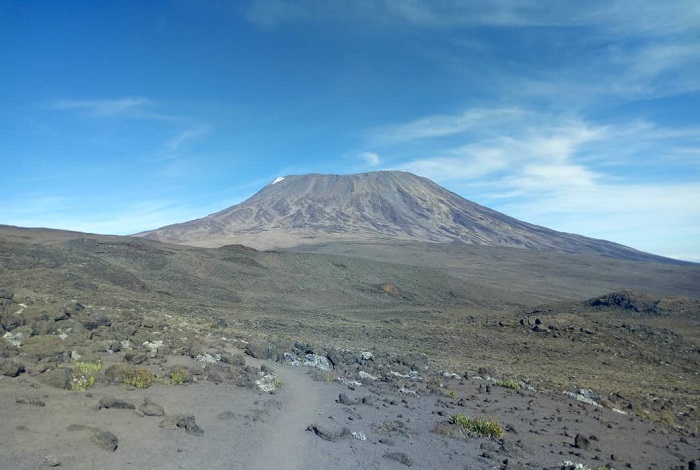
6 days Marangu Route
Adds an acclimatisation day at Horombo.

Climb Africa’s highest mountain sleeping in huts. Full day-by-day itinerary, prices from $1,350 per person and local guides from Moshi.
Book this tripSee day by day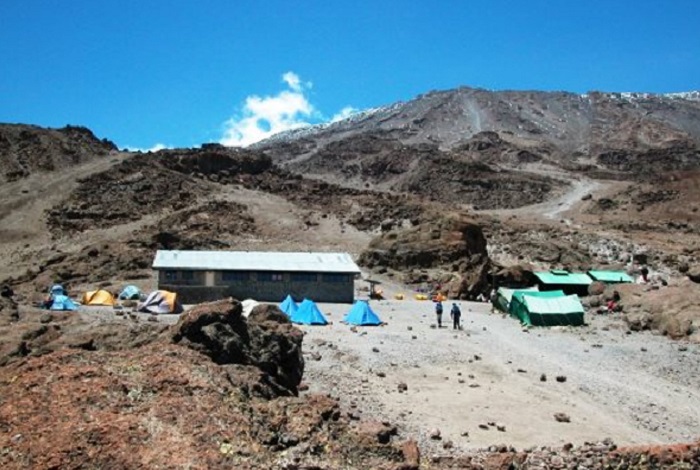
The Marangu Route, known as the “Coca-Cola Route”, is the oldest and most established path on Kilimanjaro and the only one with sleeping huts. It has the gentlest gradient and terrain, so many people call it the easiest way up. The 5 day version is the shortest way to do it: up in three days, summit on day four and down on day five.
You go up and come down the same trail, so it can be busy and the huts can fill up. It is a good trail for families and groups who want the comfort of a hut, and it is a useful choice in the rainy season because you avoid wet tents and clothes. The scenery is less varied than on other routes: forest, then a wide plateau of open ground and scrub until the final hut below the summit cone. Summit day is just as demanding as on any route.
You are picked up at Kilimanjaro International Airport and transferred to your hotel in Moshi. You meet your guide, who briefs you on the trek and checks your gear. Any missing equipment can be rented on this day.
After a morning pickup you drive to the park gate, sign in and finish preparations. The trail climbs a cleared ridge through rainforest, where most of Kilimanjaro’s animals live. You spend the first night at Mandara Hut, a group of wooden A-frame huts in a forest clearing, with flush toilets behind the main hut.
You leave camp through a short stretch of forest and into open moorland, skirting the base of Maundi Crater. In the afternoon you reach Horombo Hut, where you stay overnight.
You continue up into the alpine desert to Kibo Hut. From here the summit is only another 1,195 m of ascent. You have an early dinner, prepare your gear for the summit and try to sleep. The summit climb begins tonight.
You are woken around 11:30pm and, after a hot breakfast, start the summit push. The first stretch is a rocky path to Hans Meyer Point (5,250 m), then a steep zigzag through scree to Gilman’s Point (5,681 m) on the crater rim. From there you may find snow all the way to Uhuru Peak (5,895 m), the highest point in Africa. After photos at the top, you descend to Kibo Hut in about 3 hours, rest, pack up and trek down to Horombo Hut (about 3 hours). It is your last night on the mountain.
You make the final descent to Marangu Gate, where you started. After lunch you receive your summit certificate, then you are driven back to your hotel in Moshi.
The driest and clearest months are January to March and June to October. The long rains fall from about March to May and short rains in November, and huts keep you dry. Pack layered clothing, a warm summit jacket, waterproof shell, broken-in boots, gloves, hat, headlamp, trekking poles, a sleeping bag rated to about –10°C and a 2 to 3 litre water system. Huts provide bunks and mattresses only. Walk regularly with a daypack in the weeks before you travel, and go slowly (“pole pole”) on the mountain. Read more on our Marangu Route guide.
It is possible for fit trekkers, but there is no acclimatisation day. We recommend the 6 day Marangu for better summit chances.
Prices range from $1,700 for a solo trekker to $1,350 per person for larger groups. See the price table.
Huts. You sleep at Mandara Hut, Horombo Hut and Kibo Hut, then Horombo Hut again on the way down.
It is a steep, cold climb on scree, starting around 11:30pm to reach Gilman’s Point and Uhuru Peak. It takes about 6 to 7 hours up and 3 hours down to Kibo.
Airport and gate transfers, 2 nights in Moshi, park and rescue fees, guides, cook and porters, hut meals, drinking water, VAT, portable oxygen and a first-aid kit. Flights, insurance and tips are not included.
January to March and June to October are driest. Marangu is also a good rainy-season choice because you sleep in huts.
Adds an acclimatisation day at Horombo.
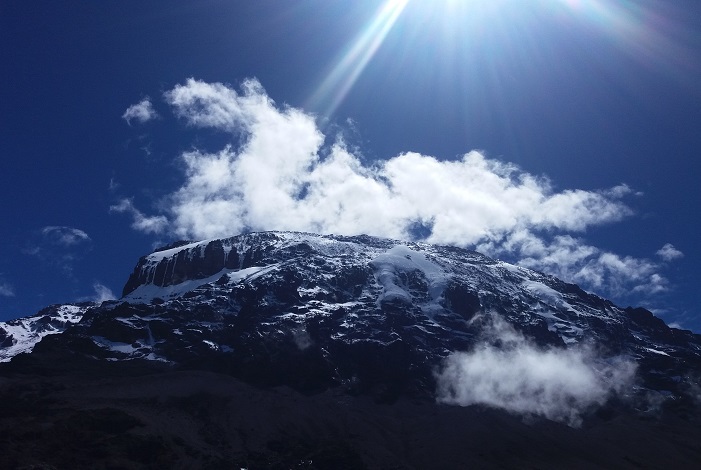
A camping route with varied scenery.
Send your dates and group size and we’ll confirm availability and your itinerary.
Book this tripCall +255 765 470 565