+255 765 470 565  |  info@viewafricaadventures.com Open daily 7:00am – 7:00pm (EAT)
Home / Kilimanjaro / Rongai Route

Rongai Route: the quiet way up from the north

The only route that approaches Kilimanjaro from the north. Drier, quieter and gentle underfoot. Choose 6 or 7 days with local guides from Moshi.

Get a free quoteSee itineraries
5,895 mUhuru Peak
6 or 7 daysTrek length
~70 kmApprox. distance
1,950 mRongai Gate
CampingTents on the trail

About the Rongai Route

As the only route that approaches the mountain from the north, Rongai is quite different from the others. You start close to the Kenyan border and walk through areas of wilderness, then join the Marangu Route at Kibo Camp, at the base of the summit massif. You come down on Marangu, so the trip is almost a complete north to south traverse of Kilimanjaro.

The northern slopes lie in the rain shadow and receive lower precipitation, so this trail is more sheltered and a good choice for the rainy season. Rongai is also much quieter than the other routes, mainly because of the extra time it takes to reach the gate at the start. For many climbers that peace makes it their favourite.

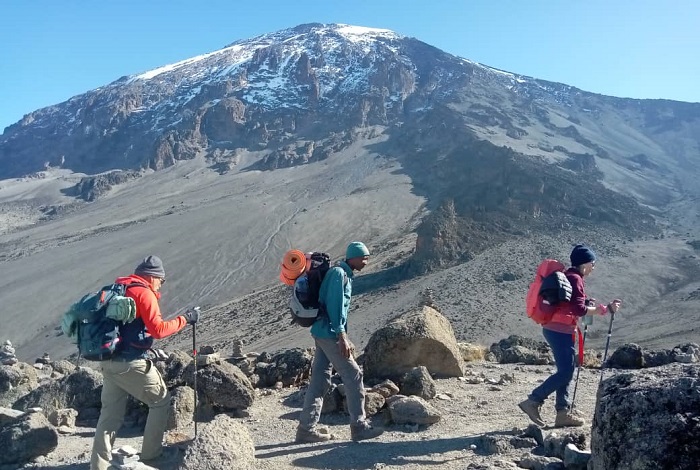
The gradient is gentle and the path is steady, taking you from farmland and pine forest onto open moorland, then up to the jagged spires of Mawenzi and across the saddle to Kibo. On the lower slopes you may see wildlife such as colobus monkeys, and the views across the plains towards Kenya are memorable.

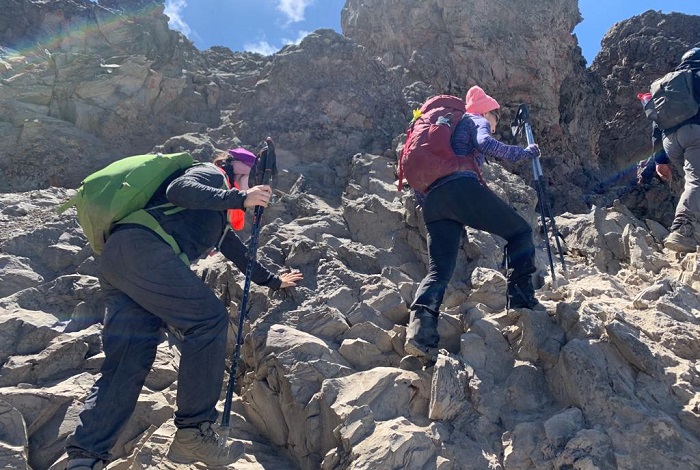
Rongai is easy on the legs, but summit night is the same long, cold climb as on every route.

Is Rongai right for you?

Good for
  • Quiet trails and fewer people
  • Rainy-season and shoulder-season climbs
  • A gentle, steady gradient
  • Anyone who wants a different view of the mountain
Think twice if
  • You want lush forest scenery (see Machame or Lemosho)
  • You want a hut bed (see Marangu)
  • You dislike long drives to the trailhead

Altitude profile and camps

Rongai Gate1,950 m Simba2,626 m Second Cave3,450 m Kikelewa3,600 m Mawenzi Tarn4,315 m Kibo4,700 m Uhuru Peak 5,895 m
Stage (7 day plan)AltitudeDistanceWalking timeZone
Rongai Gate to Simba Camp1,950 to 2,626 m~7 km3–4 hrsFarmland and pine forest
Simba to Second Cave2,626 to 3,450 m~6 km4–5 hrsForest and heath
Second Cave to Kikelewa Camp3,450 to 3,600 m~5 km3–4 hrsMoorland
Kikelewa to Mawenzi Tarn Camp3,600 to 4,315 m~4 km3–4 hrsAlpine desert
Mawenzi Tarn to Kibo Camp4,315 to 4,700 m~9 km5–6 hrsThe saddle
Kibo to Uhuru Peak, down to Horombo4,700 to 5,895 to 3,720 m~5 km up, ~15 km down12–15 hrsArctic summit
Horombo to Marangu Gate3,720 to 1,970 m~20 km5–7 hrsMoorland to forest

Distances and times are approximate and vary with pace and conditions. The 6 day plan skips the separate night at Second Cave. The drive to Rongai Gate adds time on day one.

Rongai itineraries

6 day Rongai Route Kilimanjaro trek

6 days Rongai Route

A quicker northern climb for fit trekkers with limited time.

Day by day Full itinerary details

Day 1: Rongai Gate to Simba Camp.
Day 2: Simba to Kikelewa Camp.
Day 3: Kikelewa to Mawenzi Tarn Camp.
Day 4: Mawenzi Tarn to Kibo Camp.
Day 5: Summit night to Uhuru Peak, descend to Horombo.
Day 6: Horombo to Marangu Gate.

7 day Rongai Route Kilimanjaro trek

7 days Rongai Route

Our recommended option. An extra night for a slower pace and better acclimatisation.

Day by day Full itinerary details

Day 1: Rongai Gate to Simba Camp.
Day 2: Simba to Second Cave.
Day 3: Second Cave to Kikelewa Camp.
Day 4: Kikelewa to Mawenzi Tarn Camp.
Day 5: Mawenzi Tarn to Kibo Camp.
Day 6: Summit night to Uhuru Peak, descend to Horombo.
Day 7: Horombo to Marangu Gate.

What’s included

  • Licensed, experienced mountain guides
  • Porters and a cook
  • Park entry, camping and rescue fees
  • Tents, sleeping mats and a dining tent
  • Meals and drinking water on the mountain
  • Transfers to Rongai Gate and back from Marangu Gate

What’s not

  • International flights and visas
  • Travel and medical insurance
  • Personal gear (or rental if requested)
  • Tips for guides and porters
  • Drinks and hotel nights before and after

Confirm the exact inclusions for your booking when you request a quote.

Best time to climb Rongai

The driest and clearest months are January to March and June to October. Because the north side is in the rain shadow, Rongai is also a good pick in the wetter months, but the summit can still be cold and cloudy, and you should pack waterproofs. Dry-season dates fill up early, so book ahead.

Highlights on the trail

Expect a quiet start through farms and pine forest, wide moorland, sweeping views across the plains towards Kenya, the dramatic peaks of Mawenzi from Mawenzi Tarn and the lunar landscape of the saddle before Kibo.

Summit day and altitude

You leave Kibo Camp around midnight and climb slowly through scree to Gilman’s Point on the crater rim, then continue to Uhuru Peak for sunrise. It is very cold. Walk “pole pole” (slowly), drink plenty and tell your guide about any headache or nausea. The 7 day plan gives a better acclimatisation profile than 6 days.

What to pack

Layered clothing, a warm summit jacket, waterproof shell, broken-in boots, gloves, hat, headlamp, trekking poles, a sleeping bag rated to about –10°C and a 2 to 3 litre water system. Tents and mats are provided, but bring your own sleeping bag.

Location

Rongai Route FAQs

Why choose the Rongai Route?

Rongai is the only route that approaches Kilimanjaro from the north. It is quieter and drier than the southern routes, with a gentle gradient and wilderness scenery.

Should I choose 6 or 7 days?

We recommend 7 days. The extra night gives more time to acclimatise before the summit, which improves your chances.

Is Rongai a good route in the rainy season?

Yes. The north side sits in the rain shadow and gets lower precipitation, so it is more sheltered than other routes, though the summit can still be cold and wet.

How hard is the Rongai Route?

The gradient is gentle, but summit night is the same long, cold climb as on every route. No technical climbing is needed, but good fitness is important.

Where does Rongai start and finish?

It starts at Rongai Gate near the Kenyan border, joins the Marangu Route at Kibo Camp and descends via Marangu to Marangu Gate.

How is Rongai different from Marangu and Machame?

Rongai starts from the north and is quieter, while Marangu and Machame start from the south and are busier. Rongai and Marangu share the final ascent and descent. Compare our Marangu and Machame pages.

Ready to plan your Rongai climb?

Tell us your dates and group size and we’ll send an itinerary and quote.

Request a quoteCall +255 765 470 565
Chat